At a glance
If you are evaluating a guru alternative for revenue and operations teams, you are probably not unhappy with Guru itself. Guru pioneered verified knowledge cards surfaced in Slack and the browser — solving the problem of reps opening stale docs before every call. Enablement leaders trust Guru because every card has an owner, a verification date, and a clear editorial workflow.
The question in 2026 is different. Revenue teams need answers that pull from CRM deal history, email threads, support tickets, and competitive signals in the same breath — with citations an AE can forward to a manager. They need agents that persist insights after a competitive win, not just cards someone must manually rewrite.
Gyri is an agentic knowledge base built for that second problem:
- Federated GTM stack — one query across CRM, email, Slack, and docs, not siloed app-by-app search
- Cited AI answers — synthesis with source citations your reps can trust in customer-facing work
- Context that compounds — a knowledge graph and persisted insights, not chat that resets every session
- MCP agents that write back — Claude, Cursor, and custom agents that update CRM, create insights, and run workflows
Guru wins on curated, human-verified talk tracks, in-flow card delivery in Slack and Salesforce, and mature enablement governance. Gyri targets RevOps, Sales, CS, and Enablement leaders who need cited operational intelligence that joins CRM stage, email threads, Slack decisions, and support history in one auditable answer.
For adjacent evaluations, see Gyri vs Glean and Gyri vs Notion AI.
Quick comparison
Legend: ✅ Strong · ⚠️ Partial · ❌ Not native
| Capability | Gyri | Guru |
|---|---|---|
| Federation & search | ||
| Federated search (CRM + comms + docs) | near-real-time sync across Gmail, Slack, Drive, CR… | Cards + integrations |
| Keyword + semantic hybrid retrieval | exact-match keyword search plus semantic graph ret… | Card search |
| Real-time / webhook ingestion | webhooks and scheduled crawlers keep records current | Verification cycles |
| Custom API / HTTP connectors | workspace HTTP endpoints and bridge mutations | Limited HTTP |
| Knowledge graph & multihop | ||
| Typed entity knowledge graph | people, deals, emails, threads linked as graph nodes | Cards, not live graph |
| Multihop GraphQL queries | traverse deal → contact → email → ticket in one qu… | No deal traversal |
| Cross-source correlation | joins timing, people, and language across systems | Card-centric |
| Cited answers & trust | ||
| Cited AI answer synthesis | claim-level citations to source records | Verified card sources |
| Audit trail / citation chains | full citation chain back to original sources | Verification dates |
| Insight persistence & memory | ||
| Compounding insights | structured insights accumulate across sessions | Verified cards |
| Institutional memory | decisions and context survive employee turnover | Card library |
| Version history on knowledge | insight and record versioning | Card verification |
| MCP agents & delivery | ||
| MCP-native agent endpoint | one MCP surface for Claude, Cursor, custom agents | Browser extension UX |
| Workspace-scoped auth & audit | per-workspace permissions and tool visibility | Team permissions |
| Write-back workflows | ||
| CRM / record write-back | agents update custom records and CRM fields | Limited |
| Agent-driven workflow automation | stored agents and workspace workflows on rails | Verification workflows |
| GTM workflows | ||
| Pre-call briefs | cited briefs from CRM + email + support | Not live CRM join |
| Competitive intelligence | competitor mentions across Slack and email, persis… | Battlecard cards |
| Churn / CS health signals | support themes joined to account health in CRM | Not ticket-CRM join |
| Sales enablement / battlecards | live cited synthesis vs static wiki cards | Core strength |
| Implementation & TCO | ||
| Time to value (GTM teams) | Days–weeks · pre-built connectors and graph schema | Enablement wedge |
| Connector long-tail maintenance | Managed · Gyri maintains federation layer | Integration-dependent |
| Pricing transparency | Published · see gyri.io/get-started | Enterprise sales |
Where Guru wins
Guru earned its place in the sales enablement knowledge base category for good reasons:
- Verified knowledge cards — short, authoritative answers with owner, verification date, and trust signals reps see before pasting into email
- In-flow delivery — browser extension and Slack integrations meet reps where they work without switching tabs
- Enablement ownership — mature editorial workflow for collections, verification cycles, and governance
- Collections and analytics — card views and search gaps help leaders see what content gets used and what goes stale
- Battlecard discipline — structured competitive cards with verification schedules reps actually trust
If your knowledge problem is primarily curated talk tracks and internal policies with clear owners, Guru may still be the right anchor. The gap appears when questions require live context from systems Guru was never designed to federate.

Federation & search
Gyri federates operational GTM systems into one queryable layer; Guru federates authored cards with integrations that surface them in context. Both connect company knowledge to reps, but the architectural outcome differs: Gyri joins CRM records, email threads, Slack messages, and documents as linked entities; Guru returns verified cards and search results from a card library.
Guru integrates with Salesforce and Slack primarily to surface cards in context — valuable delivery, but not federating operational data into one queryable layer. Gyri's federated search indexes Pipedrive, Insightly, email, Slack, and docs so one question assembles a cited answer across sources.
For pre-call research, a rep preparing for a renewal needs deal stage in CRM, the champion's last emails, open support tickets, and Slack threads where pricing was discussed. Guru surfaces battlecards and objection handlers — useful, all static relative to the deal. Gyri assembles a cited brief from hydrated records across systems in one response.
Guru wins when the mandate is published enablement content with verification rituals reps trust. Gyri wins when GTM teams need operational joins across CRM, comms, and support without a warehouse project first.
Knowledge graph & multihop
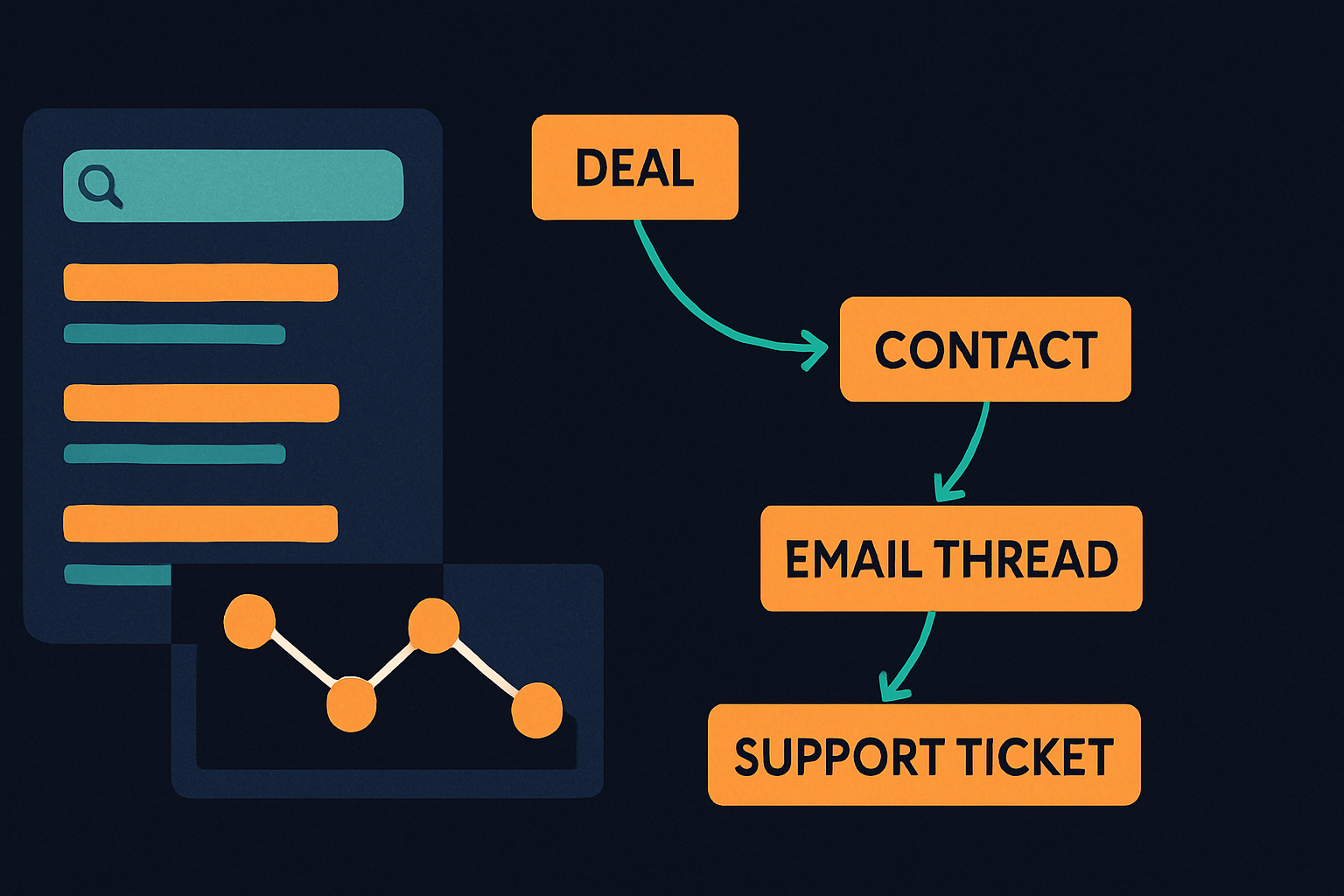
Guru organizes knowledge as verified cards; Gyri traverses a typed knowledge graph with multihop GraphQL across CRM, email, Slack, and support. This is the deepest architectural divide between a card library and an agentic knowledge base.
Guru cards excel at canonical answers your company chooses to publish: official positioning, pricing exception rules, security FAQ snippets. Gyri's graph excels at operational answers that emerge from how work actually happened — who emailed whom, which support themes preceded churn, which competitive mentions spiked in #sales-wins.
Guru finds and surfaces the best-matching cards. Related operational records do not join automatically — there is no native graph of deals, contacts, emails, and tickets. Questions like "which open opportunities over $50K have champions who went quiet in email after a P1 support escalation?" require manual correlation across Salesforce, Gmail, and Zendesk.
Gyri models connected sources as typed graph nodes — people, deals, emails, Slack threads, support tickets, insights — linked through explicit bridges. Multihop GraphQL traverses deal → contact → email → ticket in one request. See Multihop GraphQL for Business Intelligence.
Guru accelerates finding the card your enablement team published. Gyri answers relational questions directly — with citations to each record in the traversal path.
Cited answers & trust
Gyri attaches claim-level citations to every synthesized answer; Guru's trust model centers on human verification of authored cards. Revenue teams face a higher trust bar — answers go to customers, executives, and legal review.
Guru's verification model is human attestation: an expert attests that a card is current, with owner and expiration visible before a rep pastes content into email. That discipline built the category — and it remains the right model for policy snippets and official talk tracks.
Gyri's trust model is citation-first synthesis: every AI-generated claim links to source records — CRM fields, email messages, Slack threads — so the reader audits the answer, not just a badge. Gyri treats AI answers with citations as a default. See Sales Enablement with Cited AI for how cited synthesis complements static battlecards.
Revenue teams often need both: published talk tracks with clear owners, and live deal intelligence grounded in operational data. Some organizations keep Guru for the former and add Gyri for the latter.

Insight persistence & memory
Guru's card library preserves what your company chose to document; Gyri stores typed insights in the workspace graph that compound across sessions.
Guru cards with verification dates keep enablement content current — powerful for governance and content utilization metrics. That is not the same as compounding operational intelligence: competitive dossiers, account health narratives, and research conclusions that accumulate across agent runs and human sessions without manual card authoring.
When an AE departs, Guru retains the card library they referenced. Gyri retains the graph of what happened on their accounts — decisions, insights, and cited evidence linked to CRM and comms records. See Institutional Memory When Employees Leave.
Session-based chat resets every conversation. An agentic knowledge base treats each discovery as a typed object the next agent or operator inherits — so institutional memory survives turnover and onboarding.
MCP agents & delivery
Gyri exposes company context through MCP for Claude, Cursor, and custom agents; Guru delivers knowledge through browser extension and Slack card surfacing. Guru's AI direction focuses on search, summarization, and assistive authoring within the knowledge base — strong for enablement teams managing card libraries.
Gyri provides one MCP-native endpoint so agents in Claude Desktop, Cursor, and internal tooling share the same federated graph, permissions, and write-back tools. See MCP for Business Agents.
Guru wins when in-flow card delivery in Slack and Salesforce is the main adoption surface, with minimal agent infrastructure. Gyri wins when operators want agents in the tools they already use — all querying one company graph with consistent workspace-scoped auth and audit.

Write-back workflows
Guru workflows center on verification cycles and card governance; Gyri extends into agents that write back — persisting competitive insights, updating custom records, and triggering workspace workflows.
Guru verification workflows keep cards current — valuable editorial discipline. CRM write-back and cross-system automation are limited compared to a platform built around operational graph mutations.
Gyri agents write back into GTM systems with admin-defined guardrails: creating typed insights, updating custom records, and triggering workspace workflows. See Agents That Write Back.
Read-only AI helps you find the battlecard. Write-back AI helps you act on competitive intel — and leaves structured evidence behind for the next quarter's product marketing review.
GTM workflows
| Scenario | Guru | Gyri |
|---|---|---|
| Battlecards | Authored products with verification schedules | Cited synthesis that stays current from win/loss notes and comms |
| Pre-call / pipeline reviews | Playbook half of the brief | Federated cited briefs joining CRM + comms |
| Institutional memory | What the company chose to document | What happened — email, escalations, agent-captured insights |
| Competitive intel | Periodic card updates | Continuous Slack and email scanning with persisted insights |
| Churn / CS health | Search cards and policies separately | Join support themes, email tone, and CRM health in one synthesis |
Guru analytics emphasize content performance — card views, search gaps, verification coverage. Gyri analytics lean toward operational signals — cross-source patterns, insight accumulation, and graph queries that reveal account risk.
Guru wins when verified enablement content and card utilization metrics define success. Gyri wins when revenue operators need deal-grounded intelligence that cards alone cannot represent.

Implementation & TCO
Guru optimizes for enablement wedge rollout with card publishing; Gyri optimizes for a GTM workflow that proves cited federation value in the first week.
Both target mid-market and enterprise buyers with custom pricing tied to seats and integration scope. Guru rollouts often start with enablement publishing a critical collection and driving adoption through managers. Gyri rollouts often start with one high-value workflow — pre-call briefs, competitive scanning, QBR prep — where federation proves value in the first week.
Gyri publishes clearer self-serve and team paths at gyri.io/get-started. Guru pricing typically requires enterprise sales conversations.
If you already run Guru, a common path is parallel deployment: keep Guru for verified policy cards while Gyri federates CRM and comms for deal intelligence. Many revenue organizations outgrow cards-only models without discarding the enablement discipline Guru taught the category.
Verdict
Choose Gyri if:
- Your reps and operators need deal-grounded answers that join CRM, email, Slack, and docs — not only verified playbooks
- Citations to source records matter as much as human verification badges for manager and compliance review
- You plan to run MCP agents in Claude, Cursor, or internal tools against the same company graph
- You want write-back — competitive insights, QBR outputs, and health signals that persist without manual card authoring
- RevOps, CS, or competitive programs own workflows that cards alone cannot represent
Choose Guru if:
- Your primary problem is curated, verified talk tracks with clear enablement ownership and expiration workflows
- You need in-flow card delivery in Slack and Salesforce as the main adoption surface, with minimal agent infrastructure
- Compliance prefers human-attested snippets over synthesized answers, even when synthesis is cited
- Your team lacks bandwidth to federate CRM and comms — and may not for the next 12–18 months
- Content utilization metrics (card views, verification coverage) are how you measure success today
Consider both if: Guru remains your editorial layer for policy and product facts while Gyri federates operational systems for pipeline, CS, and agent workflows.
Gyri is not a drop-in replacement for Guru's card UX — it is a guru alternative for teams whose knowledge problem has moved from "publish the right answer" to "operate on everything the company knows, with proof." If that describes your 2026 roadmap, start your free trial with your stack connected and ask for a cited pre-call brief on a live opportunity — the difference between cards and a living graph becomes obvious in one query.
For category context, read What Is an Agentic Knowledge Base? and the Best Agentic Knowledge Base for GTM Teams (2026) buyer's guide.
FAQ
What is the difference between Gyri and Guru?
Guru and Gyri both connect company data to AI, but they optimize for different jobs. Gyri is an agentic knowledge base for GTM teams — federated search, multihop graph queries, cited synthesis, MCP-native agents, and write-back workflows. Guru excels at verified knowledge cards and enablement governance; Gyri is built for revenue and operations teams that need cited, persistent operational intelligence.
When should I choose Gyri over Guru?
Choose Gyri when your buyers are RevOps, Sales, CS, or Enablement; when you need multihop questions across CRM, email, Slack, and support; when citation-auditable synthesis is required; and when MCP agents and write-back workflows must compound institutional memory over quarters.
When should I choose Guru over Gyri?
Choose Guru when your primary problem is curated, verified talk tracks with clear enablement ownership; when in-flow card delivery in Slack and Salesforce is the main adoption surface; and when human-attested snippets matter more than synthesized answers grounded in live operational data.
Does Gyri integrate with MCP agents like Claude and Cursor?
Yes. Gyri exposes workspace search, graph queries, cited synthesis, and write-back tools via MCP (Model Context Protocol). Agents in Claude Desktop, Cursor, and custom tooling can query federated context without exporting data to a chat window.
Can I try Gyri before committing?
Yes. Gyri offers a free trial at app.gyri.io where teams connect CRM, email, Slack, and docs and see federated search with cited answers in minutes.